Posts Tagged ‘storage tank’
New Home Heating Oil Tank Regulations -Boston
New law requires oil heat system upgrade – Boston Real Estate – Boston.com
Under a new Massachusetts oil heating law which went into effect on September 30, 2011, every homeowner with an oil heating system is required to install an oil safety valve or an oil supply line with protective sleeve in their system. The cost is approximately $150 to $350 depending on the system. The required upgrade is to prevent leaks from tanks and pipes that connect to your furnace. The upgrade will reduce the risk of an oil leak so by making a relatively small expenditure now, you can prevent a much greater expense in the future.Who Must Upgrade?
Owners of 1- to 4-unit residences that are heated with oil must already have or install an oil safety valve or an oil supply line with a protective sleeve. Installation of these devices must be performed by a licensed oil burner technician. Technicians are employed by companies that deliver home heating oil or are self-employed. It is important to note that heating oil systems installed on or after January 1, 1990 most likely are already in compliance because state fire codes implemented these requirements on new installations at that time.Who Is Exempt? Homeowners are exempt from taking these leak prevention steps if: • the oil burner is located above the oil storage tank and the entire oil supply line is connected to and above the top of the tank OR • an oil safety valve or oil supply line with protective sleeve was installed on or after January 1, 1990, AND • those changes are in compliance with the oil burning equipment regulations; a copy of the oil burner permit from the local fire department may be used to demonstrate compliance.
Above Ground Storage Tank Registration- Delaware DNR
Deleware Department of Natural Resources
http://www.dnrec.delaware.gov/tanks/Documents/AST%20forms/AST%20Registration.pdf
Aboveground Storage Tank Registration. Doc. # 40-09-03/02/07/02
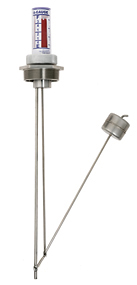
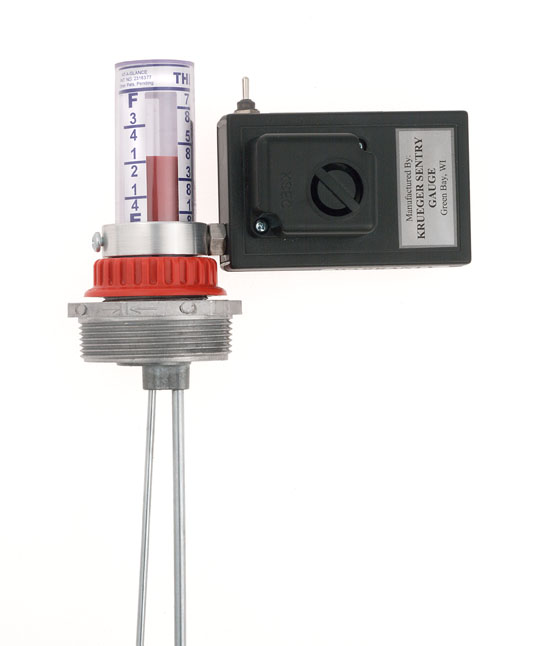
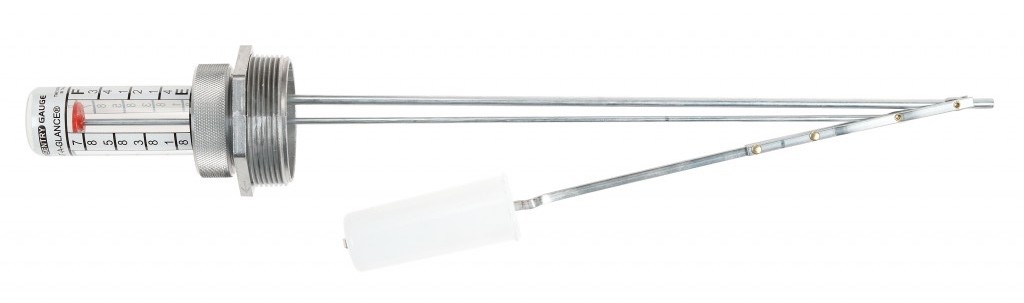
Krueger Sentry Gauge can fulfill requirements 18 and 19 of the DNR Registration Form.
18. Overfill Protection (High Level Alarm, Automatic Shut-off, Mounted Sight Glass, Manual Gauge, etc.)
19. Leak Detection (Visual Monitoring, In-tank Gauging System, Interstitial Monitoring, Soil Vapor Monitoring, SIR, Non-destructive testing, etc)
Links to applicable Products in this Post
Depending on your application:
Parts and Accessories to make your gauge more durable.
Blogged by:
Lee Geurts- Krueger Sentry Gauge Co., Inc.
Pennsylvania Aboveground Storage Tank Regulations
Inspectors from the state Department of Environmental Resources are ramping up efforts to find unregistered fuel storage tanks, as one local farmer discovered when he was recently fined by the DEP because he had not obtained a permit for his 8,000-gallon tank.
Why the increased scrutiny?
According to DEP spokesman Kevin Sunday, there was no one specific instance that sparked the agency’s actions to seek out unregistered fuel tanks.
“This is something that the department has been aware of for some time,” Sunday said, “and with the winter months coming up, we wanted to get everyone on board.”
The DEP’s effort, Sunday said, “is to make sure we register both in-ground and above-ground tanks that are not currently registered.”
So in October, DEP sent letters to 1,172 fuel oil providers across the state asking them to help find unregistered tanks. Fuel distributors are required to ask the tank owner to provide a DEP-issued registration certificate before any fuel (gasoline, diesel fuel or kerosene) can be placed in the tank.
“If the distributors deliver product to an unregistered storage tank, they are also liable for any damages” that may occur if fuel escapes from a leaky tank, Sunday said.
If DEP is not aware of unregistered tanks, it cannnot conduct routine inspections on them and the tanks could pose a threat to the environment if the tank or its pipes fail.
On page 6 of this last document, references are made to Overfill Prevention Equipment as well as Leak Detection Equipment. Krueger Sentry Gauge offers inexpensive solutions in both cases.
- Leak Detection Gauges for Above Ground Storage Tanks
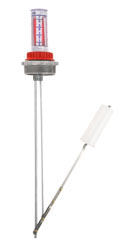
- Overfill Prevention Gauge for AST’s
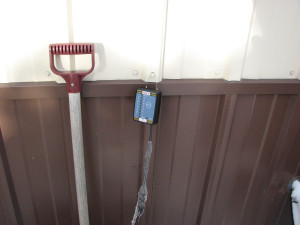
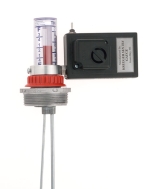
- Audible Overfill Alarm
Lee Geurts
Krueger Sentry Gauge Company
DEF Storage Tank Regulation
DEF STORAGE TANK REGULATION
Source: PEI Journal | Written by Rick Long
REGULATION OF TANKS CONTAINING DEF
BACKGROUND
Nitrogen oxide (NOx) is a major air pollutant that contributes to smog, asthma and respiratory and heart diseases. It’s a by product of diesel fuel’s high combustion temperatures, which results from the high frictional heat levels created by compressing air in the cylinders to the point at which it can ignite diesel fuel without a spark. This is unlike a gasoline engine, which uses spark ignition to burn gasoline.
Beginning in January 2010, no new on-road vehicles can be sold without meeting EPA’s tougher Tier 2 Emission Standards
for Light Duty and Heavy Duty Vehicles. The new standard is 0.2 grams of nitrogen oxide (NOx) per brake horsepower. This regulation will reduce allowable nitrogen oxide levels by 90 percent from today and by 96 percent from 1994.While gasoline engines have no problem meeting the new standard, vehicles with diesel engines have to utilize new technology to achieve the more stringent emission regulations.
The technology most vehicle and engine manufacturers will rely on is Selective Catalytic Reduction (SCR), which uses a urea-based diesel exhaust fluid (DEF) and a catalytic converter to change smog-forming nitrogen oxides into harmless nitrogen and water vapor. SCR treats exhaust gas downstream of the engine. Small quantities of DEF are injected into the exhaust upstream of a catalyst, where it vaporizes and decomposes to form ammonia and carbon dioxide. The ammonia (NH3) and SCR catalyst then convert the NOx into nitrogen and water.
COMPOSITION OF DEF
Current DEF formulations are a nontoxic, colorless and nearly odorless mixture of 32.5 percent chemical urea and 67.5 percent deionized water. Urea is the nitrogen-containing compound that transforms into ammonia when heated. Similar urea/water compounds are used in various industries, including extensive application as an agricultural fertilizer.
DEF is not a fuel; it also is neither flammable nor combustible. The product is also extremely heavy—at just over nine pounds per gallon.
STORAGE OF DEF
The industry expects diesel exhaust fluid (DEF) to be stored in small-size containers, drums, totes and intermediate bulk
containers (IBCs), as well as in bulk from both aboveground and belowground tanks.While the initial supply of DEF will most likely be in packaged containers, larger-scale bulk storage and dispensing is just around the corner. One example suggests why: New truck models will have onboard DEF tanks capable of storing up to 20 (or more) gallons of DEF. A driver with even a mid-sized 13-gallon DEF tank would have to cart and pour almost 120 pounds of packaged DEF for a complete fill-up (13 gallons x 9.2 pounds per gallon = 119.6 pounds).
Given such realities, our industry must understand as quickly and authoritatively as possible how the federal government and
the states plan to regulate larger-scale bulk storage and dispensing of DEF. Good information will be crucial if businesses are to make sound decisions and commitments in the design of their DEF refueling operations.ABOVEGROUND DRUMS, TOTES, IBCS, AND TANKS
Most people associated with the petroleum marketing and equipment industries know that aboveground tanks (ASTs) storing “oil” are regulated by EPA under the Spill Prevention, Control and Countermeasure (SPCC) rule. Since DEF is composed of aqueous urea which does not meet the SPCC definition of “oil,” ASTs containing DEF (including drums, totes, IBCs and tanks) are not regulated by EPA.
However, a word of caution is necessary here: Some states develop and enforce regulations that are more stringent than the federal rules. Check your state’s aboveground storage tank regulations before installing any AST containing DEF.
OVERVIEW OF FEDERAL UST PROGRAM
The federal underground storage tank (UST) regulations apply only to underground tanks and piping storing either petroleum or certain hazardous substances.
Today, the federal EPA estimates that approximately 617,000 underground storage tanks at close to 233,000 facilities operate under the federal UST program. Nearly all these USTs contain petroleum. Most estimates are that less than 10,000 tanks hold hazardous substances covered by the UST regulations.
Just as DEF does not qualify as an “oil” under EPA’s AST program, aqueous urea is not a “petroleum” substance under EPA’s UST program and therefore is not regulated as a petroleum product.
By itself, aqueous urea also falls outside of EPA’s definition of a “hazardous substance.”
Some confusion in the regulatory community develops, however, because DEF may contain up to 0.2% ammonia, and ammonia is one of about 1,200 substances identied as a hazardous substance under the Comprehensive Environmental Response, Compensation, and Liability Act (CERCLA). That becomes important because UST systems that store substances identied as hazardous under CERCLA are subject to the same requirements as petroleum UST systems, except that hazardous substance tanks must have secondary containment and interstitial monitoring. That means hazardous substance USTs must meet the same requirements as petroleum USTs concerning correct installation, spill, overll and corrosion protection, corrective action, and closure.
DE MINIMIS CONCENTRATION?
But another wrinkle may come into play in determining whether CERCLA will apply to UST systems containing DEF.
The federal rules exempt from federal UST regulations “any tank system that contains a de minimis concentration of regulated substances.” Rather than dening de minimis, the rules permit EPA to determine de minimis levels on a case-by-case basis. In the past, EPA has used the de minimis exception to exempt materials with very small, trace amounts of hazardous substances.
Since the amount of ammonia present in DEF USTs is very small, it is very possible that EPA will determine the level of ammonia would be regarded as de minimis and therefore exempt from federal UST regulations.
The industry has two other things going for it which may lead EPA to exempt DEF. First, the DEF manufacturers and others are very concerned not only with incompatible equipment materials causing the DEF to degrade and/or be contaminated, but also with DEF causing corrosion or somehow reducing the integrity of the equipment that can cause risk to the environment.
That, coupled with the willingness of various groups within the DEF community to insist on secondarily contained underground tank systems with interstitial monitors, might help the decision makers at EPA determine that the environmental risk from DEF USTs will be minimized, even absent EPA regulations.WHAT HAPPENS NEXT?
The ball is now in EPA’s court. EPA is in the process of developing an official interpretation on whether DEF USTs will qualify for the de minimis exemption. We anticipate an answer soon—most likely this summer—but we don’t have one yet. Once EPA issues its interpretation, PEI will let you know.
Please note: As with ASTs, state UST regulations may be more stringent than EPA’s. Check your state’s UST regulations before installing an UST containing DEF. State UST program contact information is available at EPA’s website www.epa.gov/oust/states/statcon1.htm.
Rick Long is a lawyer and the General Manager of PEI.
Excellent Article by the PEI.
DEF Gauge for AST’s
New Vermont Above Ground Storage Tank Installation Regulations and Solutions
Vermont’s Above Ground Storage Tank Rules
What is required for new tank installations?
All new tank installations must have….
http://www.vermontfuel.com/ASTfaqs_files/VTsabovegroundstoragetankregs.pdf